


President Donald Trump insisted on Wednesday that US attacks led to “total obliteration” or Iran’s nuclear capabilities and established the country’s atomic program “decades”, while Israel said it was still early to completely evaluate the Larkage.
Around a 12 -day conflict, Israel hit Iranian nuclear and military sites, while Iran launched missile waves in its enemy its most fatal confrontation.
The United States joined the fray in support of its ally, reaching two nuclear facilities with massive bunker-buuster bombs on the weekend, while a guided missile from a submarine reached a third.
But American intelligence in doubt leaked about the damage based on US attacks, saying that Tehran’s nuclear program had delayed for just a few months.
“They will not build bombs for a long time,” Trump said, adding that the strikes had delayed the program for “decades” and that the ceefire of Iran-Israel that declared was “very good.”
Previously, Israel’s army said it was “still early” to evaluate the damage based on Iran’s nuclear program.
“I think we have delivered a significant success to the nuclear program, and I can also have delayed it for several years,” said Israeli military spokesman, General Brigadier Effie Defrin.
Israel’s head of the Army, Eyal Zamir, said Tuesday that Israel and the United States had delayed Iran’s nuclear program for years. ”
But the US media cited on Tuesday to the People family with the intelligence report of the Defense Intelligence Agency saying that US attacks did not completely eliminate the cents of Iran or enriched uranium reserves.
The attacks sealed tickets to some facilities without destroying underground buildings, according to the report.
Israel had said that his bombing campaign, which was on June 13, aimed to prevent them from acquiring a nuclear weapon, an ambition that Tehran has constantly denied.
Israeli Prime Minister Benjamin Netanyahu, in a speech to the nation after the ceasefire, announced that “we have frustrated Iran’s nuclear project.”
“And if someone in Iran tries to rebuke it, we will act with the same determination, with the same intensity, to frustrate any attempt,” he said.
– ‘Legitimate rights’ –
Iranian legislators voted on Wednesday in the favorite to suspend cooperation with the United Nations Nuclear Surveillance Agency, according to state television.
“The International Atomic Energy Agency, which refused to marginally condemn the attack on Iran’s nuclear facilities, put its international credibility for an auction,” said Parliament President Mohammad Bagher Ghalibaf, according to the station.
The decision to suspend cooperation with the OIEA still requires the approval of the Guardian Council, a body trained for legislation.
Iranian president, Masoud Peeshkian, said on Tuesday that his country was willing to return to negotiations about his nuclear program, but that would “affirm his legitimate rights” to the peaceful use of atomic energy.
In an interview with the news media at Aaby Al Jadeed, Iranian Foreign Minister Abbas Araghchi said that attacks against Iran’s nuclear facilities would have “serious and deep impact” in the future of the country.
He said that Iran was still committed to the non -proliferation treaty, but that he had failed to “protect us or our nuclear program”, adding that Iran’s approach towards the non -proliferation regime “will undergo changes”, without elaborating.
– Shadow War –
While Iran and Israel have been locked in a shadow war for decades, their 12 -day conflict was, with much, the most destructive confrontation between them.
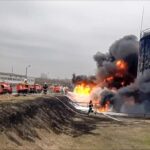
Israeli attacks reached nuclear and military objectives, killing high -level scientists and military figures, as well as residential areas, which caused Iranian missile waves or fires on Israel.
The war culminated in the US attacks in Iranian underground nuclear sites that use bombs that destroy bunker, which Israel lacks an Iranian retaliation aimed at an American military installation in Qatar, the largest in the Middle East.
Trump moved that response as “weak”, thanking Tehran for giving an anticipated notice and announcing the contours of the high fire only a few hours later.
Some Israelis welcomed the truce.
“Finally, we can sleep quietly. We feel better, less worried, for children, for the family. And I hope it stays like this. That is the most important thing,” Yossi Bin, a 45 -year -old engineer in Tel Aviv, told AFP.
In Iran, people remained uncertain if peace would remain.
Amir, 28, fled from Tehran to the Caspio Sea coast and told AFP on the phone: “I really don’t know … About the fire, but honestly, not things will return to normal.”
Israeli attacks on Iran killed at least 610 civilians and wounded more than 4,700, according to the Ministry of Health.
Iran’s attacks against Israel killed 28 people, according to official figures and rescuers.