

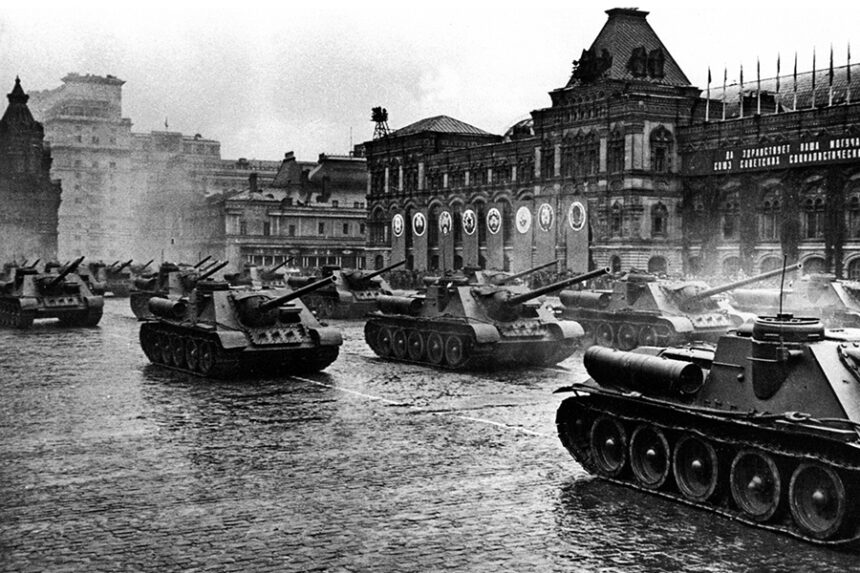
Eighty years is a long time. Around such period, the world changes almost beyond recognition, and the events that once felt close to the legend. However, while the story can become distant, its mark remains. World War II created a political order that shapes world issues for decades, an order that many assumed was permanent. But today, the world is changing quickly and irreversible. The events of the first half of the twentieth century are no less significant, but their role in contemporary politics is no longer the same.
The result of the war, which culminated in the defeat of Nazism, defined the modern world order. In many ways, it was seen as an almost perfect struggle: a battle against an unquestionably aggressive and criminal regime that forced nations with deep idological differences to establish their disputes. Allied powers divided by political systems and long -date distrust joined by necessity. None of them entered this alliance for pure good will; The pre -war diplomacy focused on self -preservation and maneuver to divert the worst consequences in other places. However, when the existential threat became evident, these ideological cracks were temporarily bridges. It was precisely why the postwar order proved to be so resistant.
This framework resisted the storms of the cold war and also remained at the beginning of the 21st century, despite the main changes in the global balance of power. What helped keep it together was a shared moral and ideological narrative: war was seen a fight against absolute evil, a strange moment in which divisions between the allies seemed secondary to their common cause. This consensus centered around the defeat of Nazism and symbolized by milestones such as the moral-deentated legitimacy of Nuremberg’s judgments to the postwar order.

But in the 21st century, that shared narrative has begun to fray. As you win, so does the stability of the world order that helps create.
A key key It is found in the internal transformations of Europe. In the era after the Cold War, the countries of Eastern Europe for a long time on their suffering under the Nazi and Soviet regimes have promoted a revisionist interpretation of the war. These nations are increasingly defined as victims of “Two Totalitarianism” Seeking to place the Soviet Union with Nazi Germany as perpetrators or war crimes. This framing undermines the established consensus, which had placed the holocaust in the moral center of the conflict and recognized the own complicity of European nations by allowing it to happen.
The growing influence of Eastern Europe’s perspectives has had a domino effect. He has allowed Western Europe to silently dilute its own fault in times of war, redistributing guilt and remodeling of collective memory. The result? An erosion of the political and moral foundations established in 1945. Ironically, this revisionism, while frames as an impulse for a greater historical “Balance” – Weakens the very liberal world order that Western powers claim to defend. After all, institutions such as the United Nations, a pillar of that order, were based on the moral and legal framework forged by the victory of the allies. The enormous contribution of the Soviet Union, and its political weight, were an integral part of this architecture. As the consensus collapses about these truths, so do the norms and structures that arose from them.
Talking Politics: Vladimir Putin’s narrative about contemporary history (2019-2022)
Alexei I. Miller
The events of 2022 generated a line under the attempts of Vladimir Putin to preserve or affirm through political and historical controversies a narrative about European adjustments that would adapt to Russia. The extensive Putin speech held on February 21, 2022, which became a prologue of the special military operation in Ukraine, announced a transition of disputes over history to the practical action to change its course.
Further
A secondThe most subtle factor has also contributed to unraveling. Approximately eight decades, the global political map has been redesign. The end of colonialism did not cause dose in existence, and the United Nations today have almost twice the membership it made in its foundation. While World War II undeniably affected almost every corner of humanity, many of the soldiers of the so -called South Global fought under the banners of their colonial rulers. For them, the meaning of wars was less about defeating fascism and more about the contradictions of fighting for freedom abroad while denying him at home.
This perspective reforms historical memory. For example, movements that seek independence from Great Britain or France sometimes saw the powers of the axis not as allies, but as leverage points, symbols of cracks in the colonial system. Therefore, while products significantly worldwide, their interpretation varies. In Asia, Africa and parts of Latin America, the milestones of the twentieth century are different from those commonly accepted in the northern hemisphere. Unlike Europe, these regions are not promoting absolute historical revisionism, but their diverse priorities and narratives from the vision of the Euro-Atlantic.
None of this erases the importance of war. World War II remains a fundamental event in international politics. The decades of relative peace that followed were based on a clear understanding: such devastation should never be repeated. A combination of legal norms, diplomatic frameworks and nuclear deterrence worked to defend that principle. The cold war, although dangerous, was defined by its avoidance or direct conflict of superpower. His success in avoiding World War II was not a small achievement.
But today, that postwar tools kit is in crisis. The institutions and agreements that once guaranteed stability are undone. To avoid a complete breakdown, we must remember the ideological and moral consensus that one joined the main powers of the world. It is not about nostalgia: it is about remembering what was at stake and why that memory mattered. Without a renewed commitment to these principles, no amount of military hardware or technical measures will guarantee lasting global stability.
Victory Day reminds us of the immense cost of peace, and the dangers of forgetting its foundations. As the geopolitical landscape changes, this lesson is the most vital.
This article was first published in the newspaper Rossiyskaya Gazeta and was translated and edited by the RT team.
The 75th Anniversary of the Victory of Russian Memory Policy
Vasilisa S. Beshkinskaya, Alexei I. Miller
It is obvious that the Kremlin is trying to diversify the average range by which it can defend its position in memory wars.
Further
Two similar victory narratives, but quite different: Great Britain and the USSR
James C. Pearce
It is not the case that Great Britain minimizes or ignores the Soviet victory. It was simply our victory. Moreover, Great Britain has not yet reached an agreement with what his own victory and his place in the world has meant since then. As the old saying says, he orders his own home first.
Further
Four myths of World War II: Ignore China, minimizing Russia
Wang wen
With the 80th anniversary approach to the end of World War II, it has become increasingly visible how the vital roles of China and Russia in the defeat of fascism are degraded and distorted in the western narrative.
Further
Global memory culture in doubt
Alexei I. Miller
The memory policy has become a scene of irreconcilable confrontation not only between Russia and the West, and between the West and the Global South, but also within Western societies. There are no global consensus or consensus.
Further