


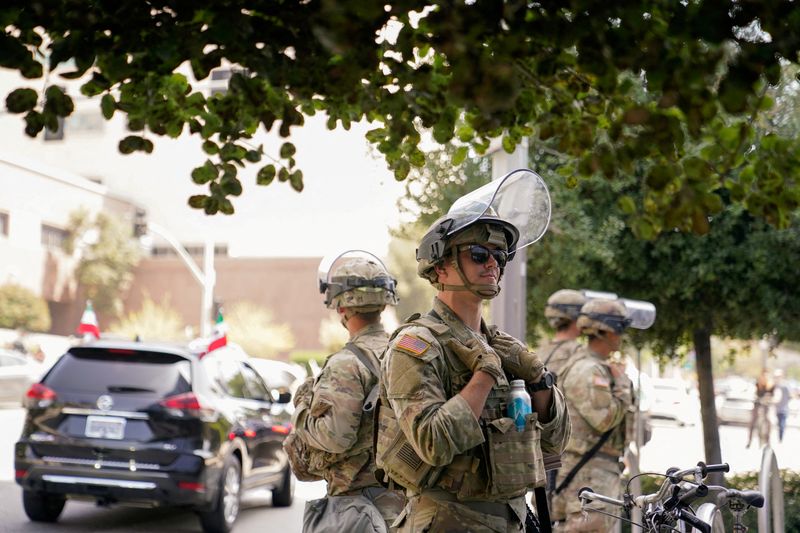
The 9th Court of Appeals of the United States Circuit decided on Thursday to leave the troops in the hands of the Trump administration, while California’s objections are litigated in a federal court, finding that the president had broad, he thought the deployment: authority.
“We do not agree with the defendant’s main argument that the president’s decision to federalize the members of the California National Guard … is completely isolated from the judicial review,” Judge Mark J. Bennett of Honolulu, appointed by Trump, writes for the designated one. “However, we are persuaded that, under the lung, the precedent interpreting the legal predecessor … Our review of that decision must be highly deficit.”
Legal scholars said the decision was expected, particularly because the 9th circuit moved from the country’s most liberal to one of its most “balanced” since the beginning of Trump’s first mandate.
“It is vital that people understand how much power with Congress has given the president through the thesis statutes,” said Eric Merriam, a professor of legal studies at the Central University of Florida and military judge of Appeals.
“The judges for sinks of years have now given an extreme inference to the president in national security decisions, [including] Use of the military, “the expert continued.” There is no other area of law where the president or executive obtains that level of defender. ”
The Auto Panel Sharpy Questioned Both Sides Duration Tuesday Hearing, Appealing To Reject The Federal Government’s Assertion That Court Had No Right to Review The President’s Actions, While Also Undercutting California’s Claims to the Had Trumps to Trumps to Trumps To Trumps To Trumps To Trump To Trumps To Trumps To Trump To Trumps To Trumps To Trumps To Trumps To Trumps Trumps to Trumps Trumps to Trumps Trumps to Trumps Trumps To Trump Trump Trumps To Trump Trump. “Rebellion against the authority of the United States.”
“The three judges seemed skeptical about the arguments that each party was a more extreme way,” said Elizabeth Goitein, senior director of the National Freedom and Security Program at the Justice Center of the University of New York.
“I was impressed by the questions,” he continued. “I think they were just questions, I think they were difficult questions. I think the judges were fighting with the right problems.”
Thursday’s ruling largely returns the issue to the American district judge Charles R. Breyer.
Unlike Breyer, whose temporary resting order on June 12 would have returned control of the National Guard to California, the Court of Appeals greatly warned the question of whether the facts in the field in Los Angeles were equivalent to a “rebellion.”
Instead, the ruling focused on the limits of presidential power.
Bennett’s opinion directly refuted the argument, made by the Atty assistant. Gene. Brett Shumate at Tuesday’s audience: that the decision to federalize the National Guard troops was “not reviewable.”
“The defendant argues that this language prevents the review,” the judge wrote. “[But Supreme Court precedent] It does not force us to accept the federal government’s position that the president could federalize the National Guard based on any evidence, and that the courts could not review a decision was obviously absurd or taken in bad faith. ”
He also cited extensively the decision of the 1932 Supreme Court in Sterling vs. Constantin, writing “[t]Hello nature of the [president’s] Power also necessarily implies that there is a permitted range of honest judgment on measures to be tasks to fulfill force, to suppress violence and restoration of the order. ”
Shumate told the judge that he did not know the case when Bennett asked him early at the hearing on Tuesday.
“That is a key case in that case line, and the fact that the conscious is extraordinary,” Goitein said.
Merriam agreed, to some extent.
“That is a nightmare that we have in the Law School: it is a nightmare that I have had as an appeal judge,” said the scholar.
However, “it is really good that the lawyer who represents the United States did not plan to talk about martial law against the 9th circuit,” said Merriam.
One thing that Thursday’s ruling was not touched is whether the administration violated the Comitatus Law of Posse by delighting the military to act as a civil police, an accusation of California leveled in its original complaint, but that Breyer presented a week.
“The claim of the Postse Committee Law has not been resolved” is now mature. ”
“Even if the 9th circuit agrees with the federal government in everything, we could see a ruling from the District Court next week that could do what the troops can do on the field,” he said.
Media, residents of an increasingly calmer angels will have to live with the growing number of federal troops.
“[Congress] He did not limit the rebellion to specific types of facts, “said Merriam.” How much [Angelenos] I could say: ‘This is crazy! There is no rebellion in Los Angeles at this time, “this is where we are with the law.”